

MMI SportsTech Kick-Off!
MMI SportsTech Kick-Off!

We are excited to announce the official kick-off of our MMI SportsTech Bootcamp on Monday, April 23. Together with Eintracht Frankfurt we have worked out a challenging program that will help 15 SportsTech Startups to boost their business!
What does MMI SportsTech stand for?
Money meets Idea — MMI SportsTech is tailored to early-stage start-ups that want to raise capital for their sports business. All participants go through a fast-paced, intense bootcamp and a mindset-shifting experience, with personalised support from experienced entrepreneurs, investors, and sports industry insiders.
Bootcamp Highlights where the general public can take part in:
– Monday, April 23, 10AM: The week starts with a special guest at TQ: Axel Hellmann, member of the board of directors at Eintracht Frankfurt, will be our guest and start-off the week together with Dr. Thomas Funke, Co-Director of TechQuartier.
– Tuesday, April 24th, 6–9pm: Sport meets Tech: here you can join Eintracht Franfurt and us for a networking event and listen to a Keynote by Daniel Sobhani, CEO Freeletics at TechQuartier (for more information click here)
Get to know our Startups:
- Athlyzer GmbH: develops digital solutions directly from sports practice. With Athlyzer we pursue a new approach and combine sports and computer science.
- PlayersVote: Fan-generated performance ratings of teams & players. With PlayersVote, fans can engage before (pre-game), during (live), and after the game (post-game). Hence, it covers the entire fan journey.

- optikick: Optikick stands for Optimized Kickin with improved Performance Management. We have created an open framework, which could be easily adapted to the special requirements of clubs — even by the clubs themselves.

- 9ineSports Network: A Sports Fans Network. The first complete sports social networks for sports fans.

- spobi.net: The sport locker for athletes and teams. So you stay focussed & thrive.
- Seat X: App /Website to rate your seat and stadium experience.
- Sportmember: Our vision is to simplify administrative processes for sport clubs and teams that usually require a lot of effort, skills and paper work.
- Ticketh: Don’t ever worry about your ticket again: TICKETH is the convenient and secure way to book or sell tickets to events, both online or offline.

- Sywos: We have developed a revolutionary linear resistance technology, that can replace weights and allows instant antagonistic muscle Training.

- Quipe: With the unique QUIPE-Score we would like to make football players of all ages and levels comparable. The QUIPE score is used to record players’ performance data in the areas of technique, tactics, athletics and personality.
- Testspielportal: We have a cool looking product that makes Team Sport coaches’ lives easier. With the right partner we can win more Teams in Germany and scale the Project in different ways.
- Toni.ai Sports Chatbots: Toni.ai provides white-label chatbots for sport-clubs, leagues & Players.
- streetkickers UG (haftungsbeschränkt): A digital health company which develops an ultimate soccer training app.
- SKILLCADEMY360: Skillcademy360° the digital solution to boost fan engagement/experience.

- Game On Technologies: video technology for sports professionals.

Get to know our Speakers:
Stefan Reinartz (Impect GmbH) – Stefan Reinartz spent most part of his ten-year career as a professional football player in his first club Bayer 04 Leverkusen. He subsequently became the managing director of Impect GmbH, a start-up he founded a year earlier with his former team-mate Jens Hegeler. The company became known in 2016 when ARD presented the new and innovative analysis method called Packing.
Daniel Sobhani (Freeletics) – Daniel Sobhani is the CEO of Freeletics. Before he took over this leadership role, Daniel worked for the Boston Consulting Group. Since 2014, he has built up the bootstrapped and profitable AI based digital fitness company Freeletics with >25 million users.
Timm Jäager (Eintracht Frankfurt)- Since September 2017, Timm Jägerworks as Advisor to the Executive Board at Eintracht Frankfurt. His main focus is on all digital projects with strategic impact on the club.
Dr. Murat Ünal founded SONEAN with his team in 2013 with the idea of bundling all network science related activities.
Joachim Lauterbach (valantic GmbH) – Joachim Lauterbach wasappointed to the management of valantic GmbH on February 1st 2018. Prior to that, he had been a member of the supervisory board of valantic Trading Solutions AG for more than three years while he already lived the vision, strategy and values of the valantic Group.
Thorsten Lambertus (Frauenhofer Venture) – Thorsten Lambertus leads the Venture Incubation & Company Building team at Fraunhofer Venture.
Tim Pawlowski (University Tübingen) – Tim Pawlowski is co-founder of the European Sport Economics Association (ESEA), led various research projects on behalf of the Federal Ministry of Finance and Major League Soccer (MLS) in North America and lectured as an expert on invitation of the United Nations Children’s Fund (UNICEF) and Sport Committee of the German Bundestag.
Dr. Thomas Funke (TechQuartier) – Thomas Funke has been involved in the global start-up ecosystem for 15 years now. He is the Co-Director of the TechQuartier Frankfurt.
Fadi Naoum (SAP SE) – Fadi Naoum is Development Senior Vice President for Sports and Entertainment, the 25th industry at SAP.
Bernd Huwe (SAP) – Bernd Huwe is Business Development Director Sports & Entertainment at SAP.
Sebastian Zelichowski is working as an analyst for Eintracht Frankfurt. Prior to that he has been part of the research teams at VfB Stuttgart, 1.FC Nürnberg and Hannover 96.


It Takes a Region to Raise a Startup – Interview with Fabian Karau
It Takes a Region to Raise a Startup – Interview with Fabian Karau
One thing that comes across when talking with Fabian Karau, it is his passion. He makes it clear from the beginning of our conversation : this project is born purely out of love for the startup community.
Here is the idea : a poster where all key players, namely startups, corporates, universities, accelerators, along with the most important trends, are pictured. The concept was adopted last year in Munich (pictured below), and according to Fabian had a pretty nice impact.
”The beauty of the project is its simplicity. It’s essentially a flag for the local startup community, a way to bring some transparency and give a voice not only to established startups, who can often afford their own visibility and PR; but also the up-and-comers. It’s something that the participants are proud to take part in and then get to hang on their office walls. In Munich there was really a lot of enthusiasm about it” said Fabian, who himself had his own startup and is currently working on the prototype for his next one.

After living for 10 years in Munich where he met Sascha Bever – who invented the poster in March 2017, Fabian came back to work in Frankfurt and immediately started getting involved with the local startup scene. According to him there is a lot of momentum right now in Frankfurt RhineMain, which motivated him to renew the project with a local twist. Indeed, the first difference we notice between the Munich and Frankfurt version is that ”It takes a city to raise a startup” became ”It takes a region to raise a startup – FrankfurtRheinMain”. It’s free for startups and quite a good ROI in terms of visibility!’
In Munich the ecosystem is much more centralised, whereas RheinMain has a lot of clusters, universities, initiatives and hubs. It’s a bit more fragmented here, which makes ideas like this poster even more valuable in my opinion, as a way to bond together and show the opportunities to new founders” said Fabian.
When Fabian, who works at PwC, which supports “it takes a region”, is asked to talk about the differences between the Munich and Frankfurt startup ecosystem, he sees no benefit in comparing ecosystems. But there is one obvious differentiator: “In Munich it is the three entrepreneurship centres of the universities that really provides tremendous support to the startups. They are a huge networking intersection and support the startups with many initiatives, events, acceleration, funding, incubation, advisory and more. There is room to grow for that in RheinMain. In RheinMain every city has its own ecosystem and network, initiatives, accelerators, incubators and events everywhere but it’s time to bring them all together, share the knowhow and the opportunities for the startups, to give them the best overview of possibilities.”
If you are a startup and interested to participate, you still have a couple of days left! Applications are open until the 22nd of April at this address: http://startupregionfrankfurt.de (Sponsors interested in supporting the initiative, a non-profit, can connect directly with Fabian at fabian@ittakesacity.de

ING-DiBa announces cooperation with Fintech smartsteuer
ING-DiBa announces cooperation with Fintech smartsteuer
ING-DiBa now offers its customers the possibility to complete tax returns quickly and easily online. Germany’s third-largest bank in terms of customers announced a cooperation with Fintech smartsteuer. This step underlines ING-DiBa’s strategy of being the first point of contact for all financial matters.
‘’With our partnership we give all ING-DiBa customers the opportunity to prepare their tax returns even more easily”, says Björn Waide, Managing Director of smartsteuer. “By providing relevant client information such as name and tax ID, the tax return can be pre-filled directly and conveniently. Fast, uncomplicated and safe. “And we’re one step closer to our goal of making the tax return almost by itself.”
The offer of smartsteuer is available for customers of ING-DiBa in the area of internet banking. From there the client is directed directly to the smartsteuer website, where he goes through the further registration and the tax declaration step by step. He receives valuable tips through linked tax tips, examples and encyclopedia articles. The amount of the expected tax refund is calculated after all entries. The customer can then decide whether he wants to establish secure data transfer to the tax office via the platform. The costs of 24.99 euros are not incurred until the final transmission of the tax data. smartsteuer is the first and so far only control software to be certified by TÜV Rheinland and thus offers the highest safety standards. In addition, the solution has received several awards for its user-friendliness.
About smartsteuer
smartsteuer GmbH is Germany’s leading provider of online tax returns. Whether you are an employee, student, retiree or self-employed: Everyone can create their own tax return quickly and easily with smartsteuer and submit it cost-effectively. smartsteuer has received several awards for its user-friendliness. smartsteuer has been on the market since 2010 and has 20 employees at its headquarters in Hanover. The GmbH is a subsidiary of the Haufe Group in Freiburg.
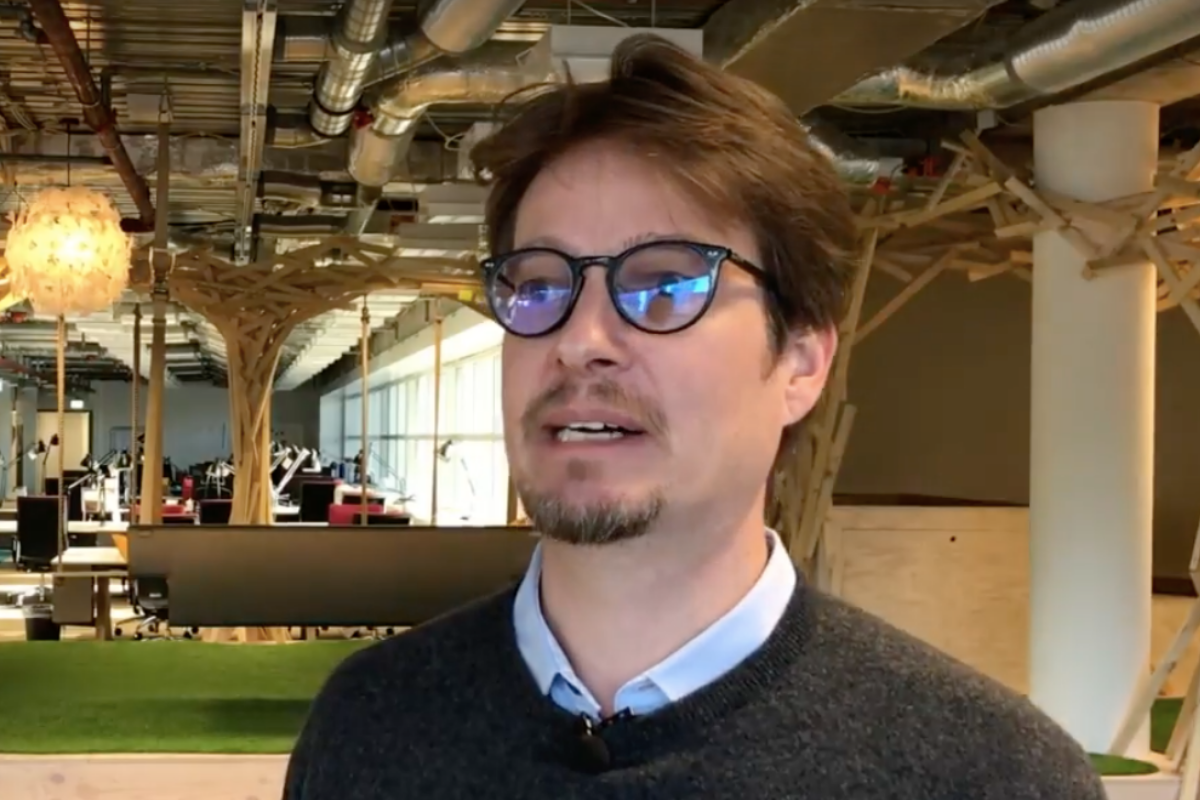
Founder Insights with Smartkarma co-founder, Jon Foster
Founder Insights with Smartkarma co-founder, Jon Foster
Jon Foster tells us more about Smartkarma, a FinTech company he co-founded which operates a digital marketplace and provides investment insights to servicing the global asset management firms.
He also shares his insights regarding venture capital (Smartkarma counts Sequoia as one of its main backers), the importance of pre-launch validations and the uncertainty that can often come with launching your own business.
Watch the full interview below:

Global Partnership Forms to Study Vibrant Frankfurt Startup Ecosystem and Identify Growth Drivers
Global Partnership Forms to Study Vibrant Frankfurt Startup Ecosystem and Identify Growth Drivers
Frankfurt (March 12th 2018) — In a unique global partnership, a 28-year-old Chinese serial entrepreneur, Startup Genome, Goethe University, and TechQuartier have come together to identify key factors in the success and growth of startup ecosystems. The project will focus on the fast-growing startup ecosystem in Frankfurt, Germany, and will generate findings that can be applied to regions across the world.
Yi Shi has built up one of Asia’s unicorn startups, DotC United Group, and has extensive international experience with large companies and startups. Studying at Goethe University motivated Shi to invest into this research initiative on the German startup ecosystem.
“I’ve been travelling between different continents (America, Europe and Asia) regularly and discovered different mindsets which impact the final approach and methodology in building a new business. And my intention to support this study, together with my alma mater, is to systematically analyze the macro and micro economic factors of building a successful startup ecosystem, in order to get a deep understanding of which measures could be done better by different stakeholders inside of the system.”
The study will use the Frankfurt Rhine-Main region and the German ecosystem as a basis for comparison with other global startup landscapes, identifying decisive framework conditions and growth drivers. A particular focus will be on the so-called scale-ups — i.e., young, fast-growing companies. A newly developed index will include growth conditions and success factor, and provide actionable insights for the German startup scene.
Startup Genome has been selected as the organization providing the international context of this project. The San Francisco-based company is the world leader in startup ecosystem assessment, delivering analytics and advice to innovation policy leaders in 30 countries to support the development of thriving startup communities. “The problem,” explains CEO JF Gauthier, “is that four cities in three countries produce more than 70 percent of Exit Value in the Tech sector. We work to identify success factors so more cities and countries can benefit from the economic value generated by startups.”
Goethe University Frankfurt and TechQuartier will bring research experience and the latest scientific findings on the topic of entrepreneurship. Their growing experience with German startups will allow them provide the Startup Genome team with additional data and resources required for the project.
“We definitely need a better understanding of what makes talented youngsters transform into entrepreneurial leaders — whether they start their own business or innovate within existing firms. The study will test our hypothesis and then pave the way for tailor-made offerings of Goethe University to its students,” said Prof. Andreas Hackethal, dean at Goethe University and Academic Director of the Goethe-Unibator startup center.
Dr. Thomas Funke, Co-Director of TechQuartier, observed, “Startups alone will not save the German digital economy. Scaleups have the potential to do so. Therefore we are focusing in particular on scaleups, all startups that are characterized by continuous growth (20 percent growth over the last three years). They deserve special attention because they are an undisputed important element for the whole economy.”
New and reliable insights into the startup scene are important to clarify the key performance indicators and the success factors that are essential to a new company’s performance. This project will generate relevant data-driven insights, clarify which measures need to be implemented next, and identify how stakeholders can significantly contribute to improve the ecosystem. The study is scheduled to be published in June 2018.
___
About TechQuartier
TechQuartier (TQ) is the central platform for the startup community in the Frankfurt Metropolitan Region, enriching the vibrant startup ecosystem with its unique community of more than 100 startups and 30 corporate partners and academic institutions. Offering over 3,200 square meters of flexible working space for startups, scale-ups, and the innovation teams of established companies, TQ offers an ideal environment for the development of new technologies, services and business models. TechQuartier has been designated by the Federal Ministry for Economic Affairs and Energy as Germany’s “FinTech-Hub.”
About Startup Genome
Startup Genome works to increase the success rate of startups and improve the performance of startup ecosystems globally. With a rigorous ecosystem assessment model based on the world’s largest primary research on startups, we work with hundreds of public and private organizations in more than 30 countries. We advise entrepreneurship support organizations, ecosystem stakeholders, and public policy leaders, bringing data-driven insights, clarity, and focus to the actions needed to produce more scale-ups, job creation, and economic growth. Find out more at www.startupgenome.com, and connect with at https://twitter.com/startupgenome and https://medium.com/@startupgenome.

A masterplan for the startup region of Frankfurt Rhein-Main
A masterplan for the startup region of Frankfurt Rhein-Main
Background. As economies around the world focus on digitalization to maintain (or increase) their competitiveness and ensure future growth, the Frankfurt Rhein-Main region is no exception. When it comes to the digital economy however, the region, along with Germany and even Europe as a whole, falls behind leaders such as the United States or China. According to a joint study by Accenture and Oxford Economics, the share of digital in the German economy was 25.9% in 2016 and is predicted to grow to 30% by 2021. In comparison, the United States‘ digital economy in 2016 accounted for 33.7% of its overall economy, and this is predicted to grow to 36.3% by 2021.
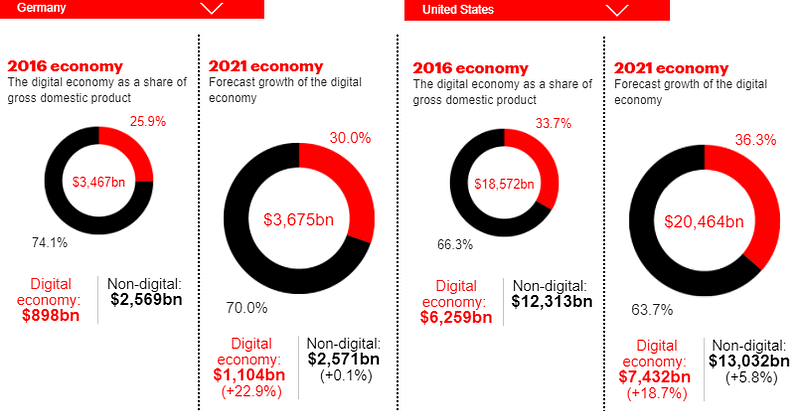
With this in mind, several new initiatives are being put in place across Germany to promote innovation of digital sectors. One of them is the Digital Hub Initiative by the Federal Ministry of Economic Affairs and Energy, which recently established 12 digital hubs throughout the country. Another one, made public today, is the Masterplan for the startup region of Frankfurt Rhein-Main, of which TechQuartier and the Hessian Ministry of Economics, Energy, Transport and Regional development are key actors.
Startups in the Frankfurt-Region
Tech startups are the growth engine for emerging digital ecosystems. Thus, the creation, growth and success of tech startups is crucial for a successful transformation. In Germany, Berlin is often cited as the primary hub for startups, being ranked 7th in the world according to the latest Startup Genome which evaluates startup ecosystems around the world. But Frankfurt is coming along; last year, it was officially introduced as part of the 2017 Genome report, and will be again in 2018.
And with good reason. The region of Frankfurt Rhine-Main is well-equipped to foster the success of startups. It is a very international city and one of the world’s most important traffic hubs. It is also one of Europe’s most important financial centre, home of the European Central Bank, the Deutsche Börse (German Stock Exchange), the Deutsche Bundesbank (German central bank) and many of the world’s largest financial institutions. With such a high concentration of banks, investment funds, insurers and other large corporations, the potential is there for a greater more collaboration with innovative startups that bring forward-thinking solutions to the table.
The Masterplan : a roadmap to success
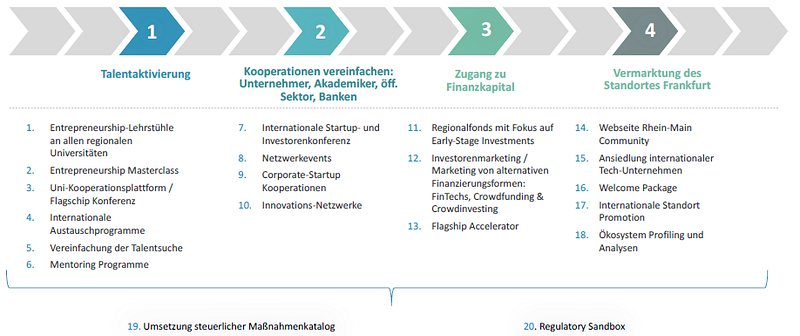
The plan launched today aims to make Frankfurt not only a leading European Fintech hub, but a global player on the startup scene. To reach this objective, 20 measures along 4 axis have been developed. They are :
Axis 1 — Talent activation
Universities are the base of a dynamic, innovative startup ecosystem. This is why the first part of the plan is to establish entrepreneurship chairs at
all universities in the Rhine-Main region, with dedicated courses and seminars on Entrepreneurship. The goal here is to position advantageously this topic as a central component of university education and solidify the burgeoning interest students have for startups as a serious career option.
Other measures include : University cooperation platform; international exchange programs; mentoring; flagship conference; simplification of the talent search; summer schools; collaboration between students, teachers and startups; establishement of a job and internship portal; job fairs.
Axis 2 — Promotion of cooperation
Major steps will be adopted to create a cooperative ecosystem with international reach. This means establishing an international startup and investor conference once a year in the region. Another prime focus will be put on networking at both the local and international level between founders and investors. Finally, something that has already begun and which is a cornerstone of TechQuartier’s implication is the cooperation between local SMEs and large companies. Corporates are always looking to solve their internal challenges and identify new business opportunities. Startups often have the key, and what is often missing is the simple action of connecting. The goal is to provide ways for both parties to be matched and generate win-win collaborations.
Other measures include : Call for project by the City of Frankfurt to solve urban problems and identify use cases or competitions; position the city as a platform for digital solutions
Axis 3 — Access to capital
A key measure to improve founders and startups access to capital is the setting up a state fund, which will invest in selected startups in the region. There will also be funds for the replenishment of potential early stage investments. Also in focus will be the marketing of alternative financing resources (crowdfunding & crowdvesting as resources for new startups, for example.)
Other measures will include : cooperation with established accelerators and offer from corresponding programs for selected startups; settlement of branch offices of internationally established companies accelerators.
Axis 4 — Promotion of the location
With the help of its partners, the state will be working closely with housing authorities to make enough new and affordable office space available, and to help solve visa issues for startups and international talent. There will also be the creation, through TechQuartier, of a web portal offering an overview, key metrics and storytelling of the local startup ecosystem. Finally, efforts will be deployed to ease the creation of innovation labs and / or subsidiaries of international tech companies, the goal being to create attractive conditions for the development and strengthening of the ecosystem.
Other measures will include : the offer a welcome package with essential
information about setting up shop in Frankfurt (workplace, apartment, RMV ticket for new founders at the location (each for 3 months); access to and expansion of international schools; International marketing of the
ecosystem and its players; representation of the Frankfurt office, its founders and start-ups in international flagship events; establishment of representative offices in established startup hotspots; annual ecosystem analysis in cooperation with established research institutions; annual FinTech analysis
These steps will be implemented with a budget of 15 to 20 million euros over the next 3 to 5 years.
The role of TechQuartier
TechQuartier is already a focal point for regional players and increasingly for international stakeholders as well. Since its inception in 2016, the organization is already a recognized name in Germany when it comes to FinTech. TQ acts as central and independent hub for regional and global FinTechs, which is why it was selected as the FinTech Hub Frankfurt by the de:hub initiative of the ministry.
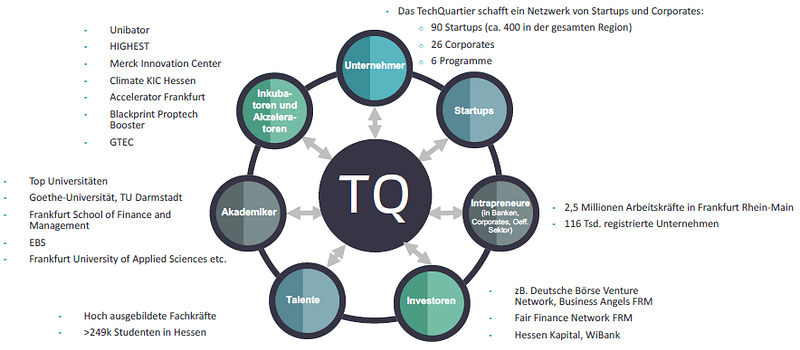
Therefore, our role will be one of coordinator of this masterplan, overseeing the implementation of several of the measures and monitoring the KPIs, along with reporting to the various collaborators at regular intervals.
It is also responsible for the international benchmarking of the regional ecosystem through the Startup Genome initiative and for the realization of the local survey of the numerous startups. This data, in turn, will be mined for insights and used as part of a new website that will ‘’tell the stories’’ of the Frankfurt Rhein-Main ecosystem and market them to an international audience. This website will be online shortly, and several of the pieces will be found here on Medium. Stay tuned!
To download the Masterplan (GERMAN)
About TechQuartier :
Located in the heart of Frankfurt, TechQuartier serves as a creative arena and melting pot for entrepreneurs and innovators. We provide access to a valuable network of startups, corporates, investors, talents and mentors, from the financial industry and beyond. More information at www.techquartier.com
If you have any questions regarding the Masterplan, TechQuartier or if you are looking for ways to join our community, please reach out to Hugo Paquin at paquin@techquartier.com