

The Five Step Process to Build a Corporate Innovation Ecosystem
The Five Step Process to Build a Corporate Innovation Ecosystem
When it comes to corporate innovation, most companies believe that pouring money into the R&D department is the way to go. However, this is not the right approach. In their book “The Corporate Startup”, Tendayi Viki, Dan Toma and Esther Gons discuss why innovation in established companies fail and the right approach to tackle innovation.
“Innovation labs created by companies fail because the innovators don’t get autonomy”
Tendayi et al. say that most managers believe that creating an innovation lab can separate the innovators from the toxic environment within the company. However, they fail to build management process around these labs to provide autonomy to the innovators.
“Creating great new products is not exactly innovation”
Once the management team of an established company sees a startup launching a new product that is gaining traction, they immediately pour money in their R&D labs, incubators, and accelerators to develop similar products. However, this is not exactly an innovation.
A unit within PricewaterhouseCoopers(PwC) called Strategy & Business has been publishing annual reports of top 1000 innovative companies in the world over the past 12 years. Their major finding was that the top 10 most innovative companies every year are often not the top 10 companies who spend the most on R&D.
Tendayi et al. define corporate innovate as-
“The creation of new products and services that deliver value to customers, in a manner that is supported by a sustainable and profitable business model”.
Therefore, corporate innovation is not just about creating new products, it is about giving the customers what they want and, in due course of fetching value to customers, providing the company tith a profitable new product. A product devoid of sustainability and profitability elements is simply a new “cool” product. It is not answering the needs of customers and it is not an innovation.
To proceed with corporate innovation, Tendayi et al. suggest the following five-step process:
1. Start with defining innovation thesis
The first step to corporate innovation is to outline an innovation thesis which aligns with the overall strategic goals of the company. An innovation thesis is similar to the investment thesis of venture capital firms. The VC firms, in their investment thesis, clearly sets out the type of investments they would pursue. For example, if a software company believe that the future is driverless vehicles then they would define their innovation thesis as investments in products for driverless vehicles.
2. Allocating innovation portfolio
Nagji and Tuff, in their Harvard Business Review article titled, “Managing your innovation portfolio”, have defined a spectrum of products in the innovation portfolio which is shown below.

Source- Bansi Nagji and Geoff Tuff. Managing your Innovation. Harvard Business Review, May 2012.
According to Tendayi et al., this portfolio should contain products that cover the entire spectrum of innovation i.e. products in core, adjacent and transformational regions of the matrix. Simply put, a company should have products in early-stage, mature and established products. The balance of the product portfolio should be an expression of the company’s overall strategy and innovation thesis.
3. Setting up an innovation framework
Defining an innovation thesis and deciding a portfolio are great steps but a framework is required to search and execute. There are various innovation frameworks such as Ash Maurya’s Running Lean Framework, Steve Blank’s Investment Readiness mode, and Tendayi Viki’s Lean Product Lifecycle Framework.
All these frameworks can be broken down into three simple steps: creating ideas, testing ideas, and scaling ideas. With an innovation framework in place, everyone in the company will know the exact stage a product is in and this can provide the basis for how a company can manage its investment decision and product development practices.
4. Select the right KPIs to measure success
After setting up an innovation framework, it is essential to not rely on traditional accounting methods. They are great to manage core products but not as great to manage innovative products since they require new tools. Tendayi et al. propose an incremental investing-based approach to manage their innovation stage products. In addition, they also propose three KPIs (Key Performance Indicators):
1. Reporting KPIs for the product teams which focus on the number of product ideas generated, number of experiments, and progress made from idea creation to scaling it up.
2. Governance KPIs focus on helping companies to make informed investment decisions (i.e. how close are the teams to finding the product-market fit).
3. Global KPIs focus on helping the company examine the overall performance of their investments with regards to their innovation context of the larger business. An example of this could be examining what percentage of revenue is made up of the investments made in development and execution of innovative products.
5. Set up and maintain a network to facilitate innovation practice
The core principle of innovation in practice is simply that no product can be taken to scale until it has a validated business model. This process requires that teams validate both the attractiveness of the products to customers and the potential profitability of the business model.
A key ingredient of this process is having a network or community. Companies must create and support communities of practices that interact regularly and share lessons on best practice. Having this setup ensures that the innovation skills are shared and developed across the company.
Source: The Corporate Startup by Tendayi Viki, Dan Toma, and Esther Gons.


3 Key Conditions of Creating a Scale-Up
3 Key Conditions of Creating a Scale-Up
Startups are progressively becoming impactful to many economies in recent years. According to the recent Startup Genome “Frankfurt Startup Ecosystem Report”, fast-growing startups, known as scale-ups, are capable of creating more jobs and two times the revenue in comparison to startups. The 2017 European Scale Up Report can also confirm this: scale-ups have provided an 23 percent increase in job availability in Europe and, overall, more potential to providing utmost economic value to stakeholders and societies across the globe. When comparing a traditional startup to a scale-up, there are several conditions which should be met to make it more likely to achieve the same extent of development.
“Startups that grow rapidly to large size–scaleup firms–are the key driver of job creation and economic impact in every country and region. These companies help thei ecosystems grow larger. creating a virtuous cycle of further scaleup creation.” -Startup Genome
ONE: Global-Orientation
In order for a startup to become a scale-up, it is important that expansion beyond regional and national borders is implemented. International expansion will make it more likely for founders to create a higher level of global connectedness. According to Handelsblatt Global’s article by consultant Martin Eisenheit, networking abroad is crucial to acceleration of the startup world, especially with regards to technology. He states that global orientation ensures that there is a mix of international developed structures, so that countries are able to work together to further their entrepreneurial ideas. The main issue in cities within Germany is the lack of global connectedness, limiting scale-up growth potential. This connection can be solidified by implementing more frequent visits to top ecosystems worldwide or by meeting other founders who visit the local ecosystems. Creating global connections means an increased likelihood to reach global markets, increased global sales, increased growth, increased performance, and, ultimately, an increased number of scale-ups.

Figure 1. The Frankfurt Scaleup Ecosystem Report shows that founders of scaleup firms have a higher level of global connection than typical startups.
TWO: Ambition
Ambition is also a key success factor for creating scale-ups because it acts as a measurement of motivation and market reach. Ambitiousness is an important characteristic that can be attributed to the majority of scale-up founders. Scale-up owners are 2.5 times more ambitious in their business endeavors in comparison to startups. However, an issue that needs to be resolved is the lack of founder ambition. In a recent article on Frankfurter Allgemeine, Julia Löhr observed that there is a lack of employment security within startups which has limited the number of entrepreneurs with the ambition required for the introduction of scale-ups. Startup Genome’s suggestion in order to increase the level of founder ambition is to strengthen the relationships with outside founders from top ecosystems in order to put forward meaningful combined efforts and strategies for the purpose of accelerating scale-up growth.

Figure 2. The Frankfurt Scaleup Ecosystem Report shows that individuals of scaleup founders have higher ambition levels than typical startup founders.
THREE: Experience
Experience especially has a considerable contribution to the creation of scale-ups. This can apply to two types: startup/scale-up experience. However, the experience and skills required for scale-up growth is lacking as well. Julia Löhr’s research states that over 440,000 skilled workers were missing from enterprises in 2017. It is important to note that within this article, it was also confirmed that the founders of most successful startups were not “hiding away” within already established enterprises, but rather were networking with businesses in early stages for advice to improve their business ideas and gain experience in the field. Scale-ups are 63 percent more likely to have founders with previous startup experience and 29 percent more likely to have previous scale-up experience (also known as “hypergrowth”).

Figure 3. The Frankfurt Startup Ecosystem Report shows that scaleups have a higher share of founders who have previous startup/scaleup experience.
By incorporating oneself into the startup community, there is increased potential for business ideas to become, not only a reality, but a fast-growing startup—scale-up—as well.
Citations
Eisenhut, M. (2018, February 20). Berlin needs to look beyond Germany for its digital future. Retrieved June 7, 2018, from https://global.handelsblatt.com/opinion/berlin-needs-look-beyond-germany-digital-future-889557
Löhr, J. (2018, April 16). Neue Gründerplattform: Wirtschaftsminister Altmaier umwirbt Gründer. Retrieved June 7, 2018, from http://www.faz.net/aktuell/wirtschaft/unternehmen/bmwi-und-kfw-starten-gruenderplattform-15544920.html
Mohaut, O. (2017, October 11). Sirris: European Scaleups Report (2017). Retrieved June 5, 2018, from https://www.scale-ups.eu/the-scale-up-landscape/2017/sirris-european-scaleups-report-q1-2017

The Disadvantaged Creating Advantages— integrating women and immigrants into Frankfurt’s startup scene
The Disadvantaged Creating Advantages— integrating women and immigrants into Frankfurt’s startup scene
There may be hundreds of active startups within the region of Frankfurt, but the city is far from where they could be. According to the Startup Genome report, there is a desperate need for more startups to contribute to economic growth. But how will this be accomplished, exactly? Surprisingly, it can be accomplished through the integration of the world’s most historically disadvantaged—women and immigrants.
WOMEN
Women, as we know, have historically faced gender discrimination inside and outside of the workplace. It is prevalent, even today, that they are not provided with the same amount of opportunity to share their business ideas or advance in their careers as men are. According to the Startup Genome report, Frankfurt is falling behind in percentage of female founders by up to 7% in comparison to leading global ecosystems, such as New York City. In a 2018 BCG report written by Katie Abouzahr et al, it was shown that even though men are provided with more funding for their startups than women are, they actually produce less revenue than women by over 10 percent. In general, connecting women to startup development and ensuring an increase of contribution from women will assist in increasing the number of startups in Frankfurt’s business community.

Figure 1. The Frankfurt Startup Ecosystem Report shows that in comparison to other cities worldwide, the percentage of female startup founders is lower than median in European and North American ecosystems.
IMMIGRANTS
Frankfurt is especially recognized for has a considerable amount of diverse inhabitants, immigrating from many part of the world. Despite its high population of immigrants, 51 percent to be specific, 91 percent of technology startups in the Frankfurt region have local founders. Their share of immigrant founders from countries outside of Germany is only 9 percent in comparison to, shockingly within Germany, Berlin, with a leading 43 percent share of foreign founders. Frankfurt’s emphasis on local talent should be expanded beyond this because, according to a 2017 DW business report by Benjamin Bathke, two thirds of Germany founders say the startup landscape of the country will reap positive benefits by integrating foreigners more actively.

Figure 2. The Frankfurt Startup Ecosystem Report also showed that Frankfurt has a lower percentage of immigrant founders than the global median.
By becoming more open to including these “disadvantaged” individuals into the startup world, it will be possible to transform Frankfurt’s low startup performance into high startup performance for the purpose of creating continuous economic growth.
Citations
Abouzahr, K., Taplett, F. B., Krentz, M., & Harthorne, J. (2018, June 6). Why Women-Owned Startups Are a Better Bet. Retrieved January 7, 2018, from https://www.bcg.com/publications/2018/why-women-owned-startups-are-better-bet.aspx
Bathke, B. (2017, October 11). Insights into Germany’s startup scene | DW | 18.10.2017. Retrieved June, from http://www.dw.com/en/insights-into-germanys-startup-scene-entrepreneurship-funding-venture-capital-investing-expansion/a-40993536

Fostering Scaleup creation in Frankfurt by globalizing its Startup Ecosystem
Fostering Scaleup creation in Frankfurt by globalizing its Startup Ecosystem
In the race to become the next scaleup producer ecosystem in the world, Frankfurt is trailing behind other comparable ecosystems.
Startup Genome, in their latest ecosystem report on Frankfurt, outlined three areas which must be improved to position Frankfurt as the next big startup ecosystem.
According to the Genome report, currently, globalization is the key element lacking in the Frankfurt ecosystem. Globalization will facilitate an increase in the level of quality and ambition of founders and in turn promote rapid growth and lead to the production of more scaleups. In general, Frankfurt is already an international city and is known as one of the international financial capitals, however, the internationalism has not fully amalgamated in the startup ecosystem.
Increase Global Connectedness
Global Connectedness refers to quantifiable meaningful relationships that exist between startup leaders and how they were developed. Global Connectedness increases global market reach by bringing global know-how into an ecosystem.
“Five to ten years ago, local connectedness between the different cities and assets of the Rhine-Main region was not a priority. For example, People from Frankfurt didn’t really know what was happening in Darmstadt and vice versa. Even larger Exits and Successes were not widely communicated. This has changed in recent years with the need for startup cooperation being more and more acknowledged by incumbents. Today, various institutions such as the Goethe Unibator and the Techquartier lead the community management, ensuring that incumbents and startups get together and that exchanges between startups are encouraged”
Ingo Franz
Business Angel and Partner of Kreaxi Ventures
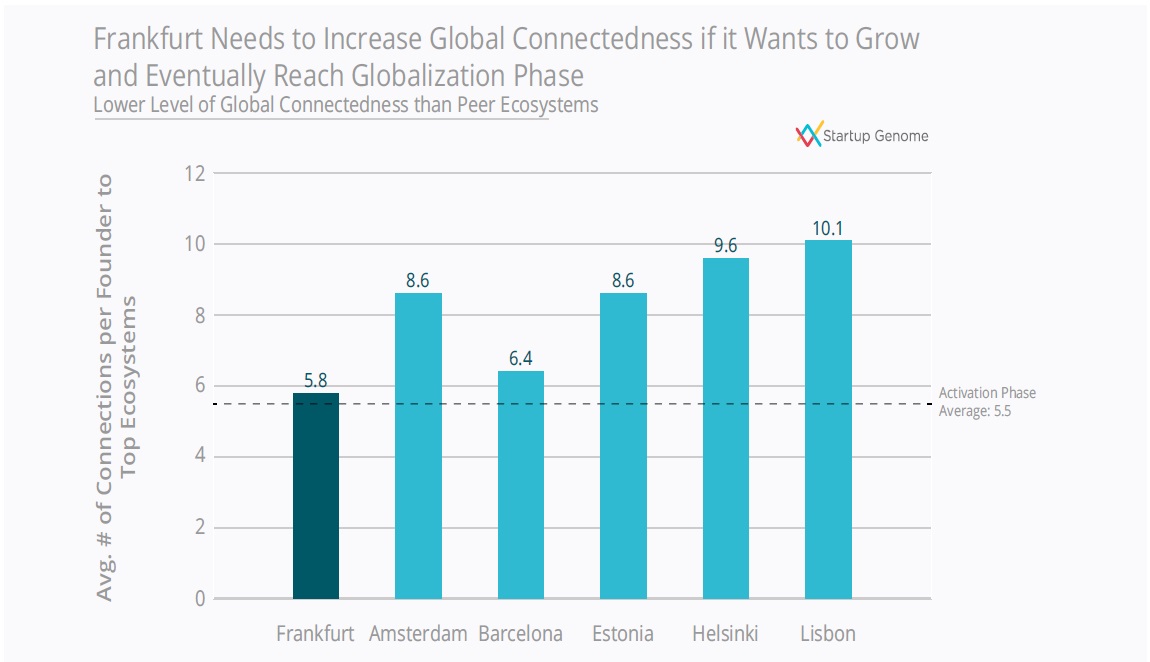
In Startup Genome’s analysis, Frankfurt founders said that they often meet founders from top ecosystems locally and by traveling to those places. As a result, Frankfurt exhibits a fairly good level of global connectedness for an ecosystem that is still in the activation phase. Considering Frankfurt’s position as an international city, the number should have been much higher. Additionally, the numbers must be ramped up to take Frankfurt’s ecosystem to the next phase.
Founders in Frankfurt must think global
A striking characteristic that separates the scaleup firms from the non-scaleup firms is their global ambition. Scaleup firms do not limit themselves to a particular geographic territory. According to the Startup Genome report, only 17% of customers are served by Frankfurt-based startups are international (outside Europe).
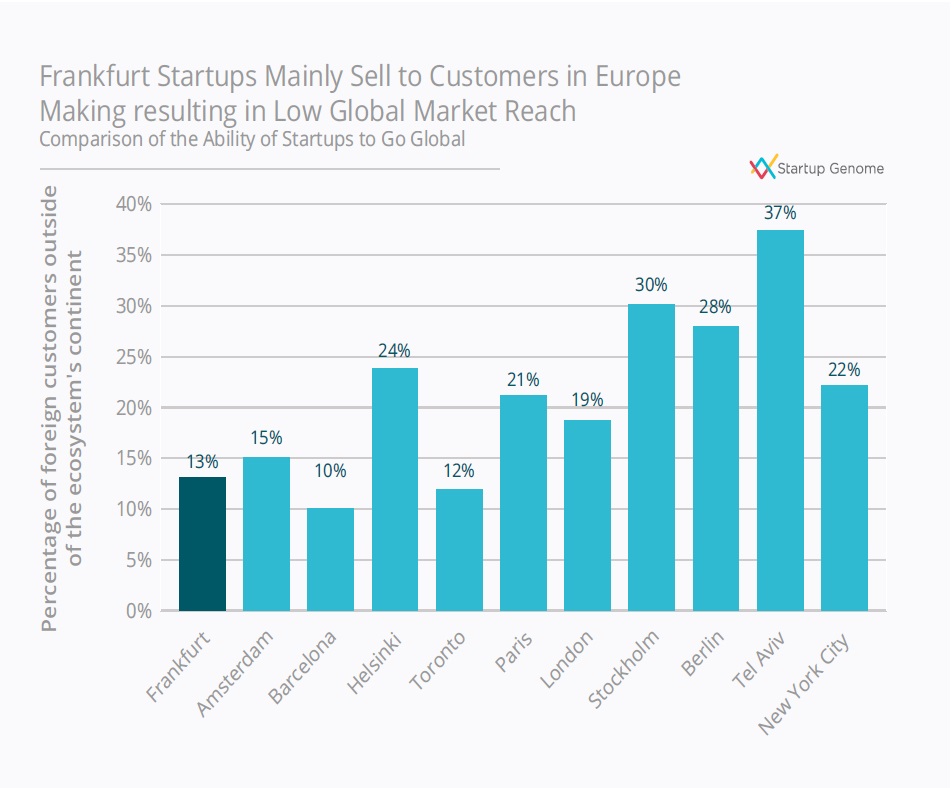
Being in the middle of an integrated market (the European Union) and in a region that has headquarters and subsidiaries of multinational companies, Frankfurt startups receive the incentive to not look beyond the European borders for customers.
To go to the next phase, it is vital for Frankfurt-based founders to have more of a global ambition. Entering global markets can be competitive but without taking the risk of going global, it will be extremely difficult for the majority of startups in Frankfurt to achieve the scaleup tag. Continuance of the current practices of focusing just on European market will limit Frankfurt’s ecosystem to reach the next phase of ecosystem life cycle.
Increase the number of Immigrant Founders
Frankfurt has a high population of immigrants (In a study conducted by Germany’s Office of Multicultural Affairs, more than half the population of Frankfurt in 2015 consisted of immigrants).
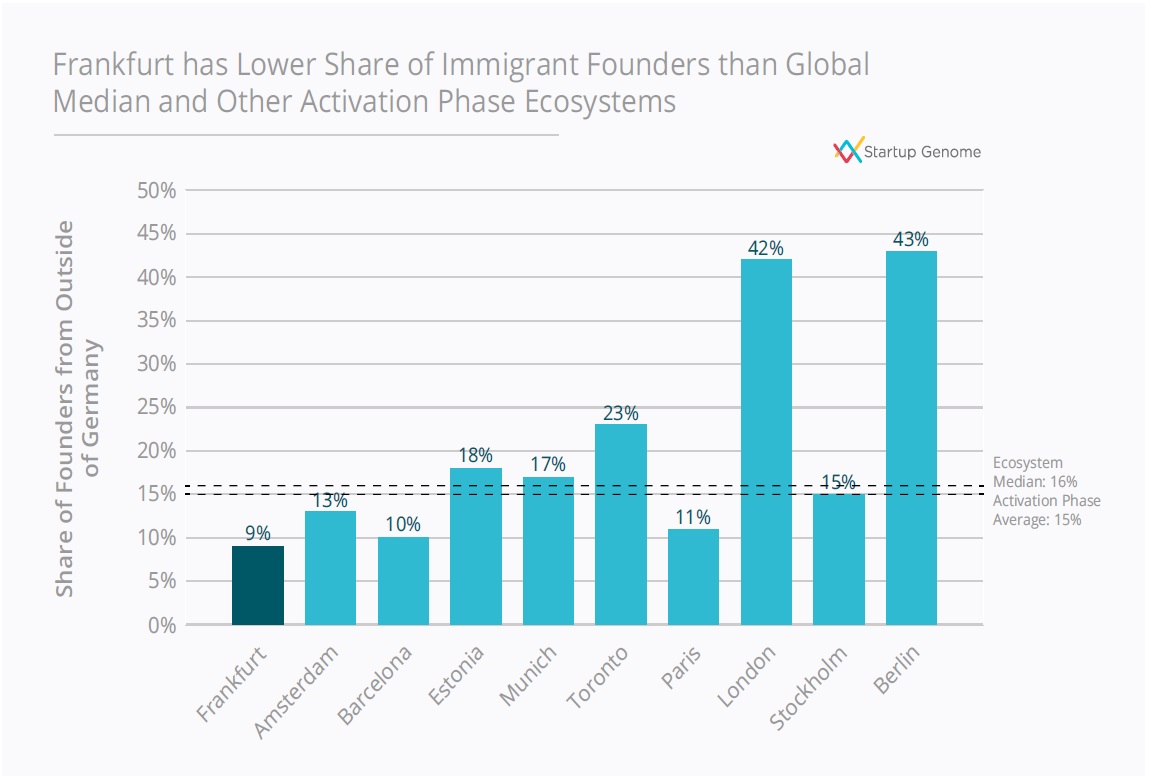
Despite having high diversity, Startup Genome reports that only 9% of tech founders come from an immigrant background. This rate is substantially lower than both the global median and average among other Activation phase ecosystems. According to an article posted in the Economist, the share of new businesses (all kinds of businesses) in Germany started by foreign passport holders has increased from 13% in 2003 to 44% in 2017.

Breaking the Myth: Do Larger Funding Rounds Signal Scaleup Creation?
Breaking the Myth: Do Larger Funding Rounds Signal Scaleup Creation?
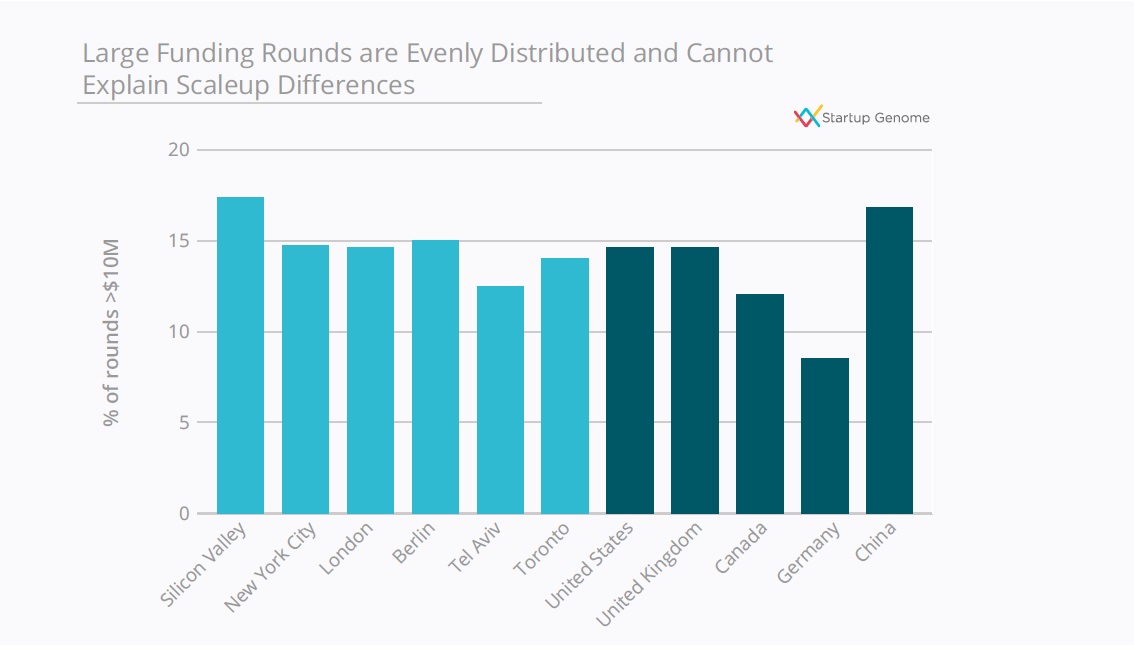
Scaleup firms or firms showing high growth generally raise larger funding rounds than non-scaleups. It is often a perceived notion that firms raising larger funding tend to become scaleups. According to Startup Genome’s latest report, it observed that large scaleups (those companies reaching billion-dollar valuation and those having exits over $100 million) raise more than $10 million in series A compared to all other Series A rounds.
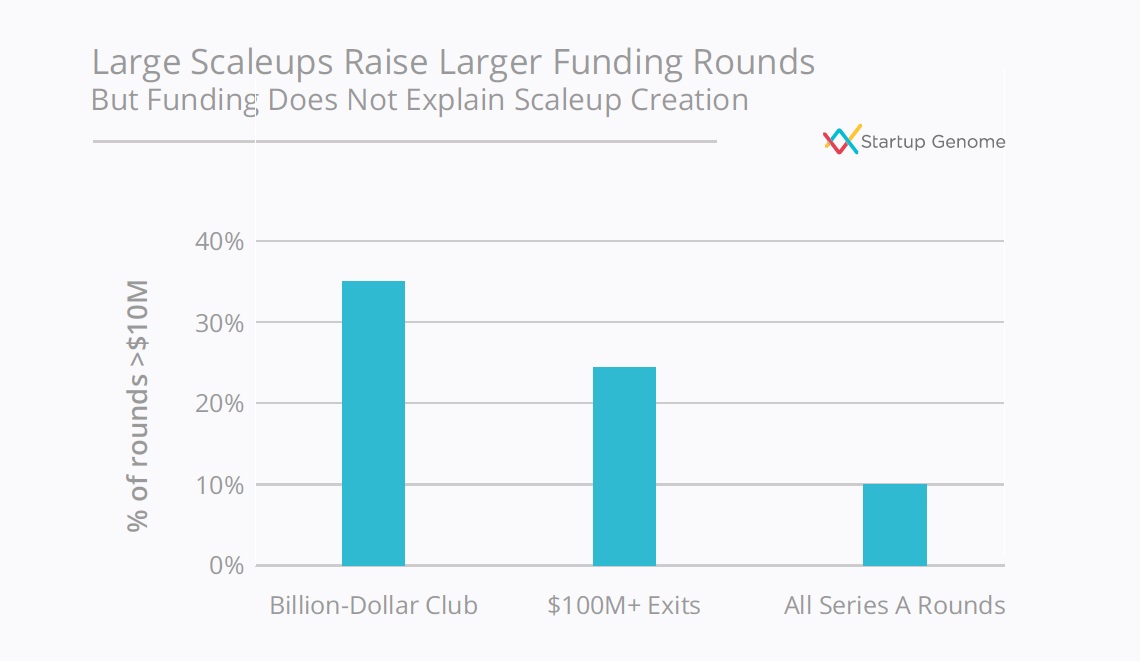
Looking at this statistic, an inference can be drawn that larger funding rounds signal that a startup is on the way to become a scaleup or even a unicorn. Policymakers take this logic seriously and start making plans to pour more money to increase funding rounds. However, this approach is quite flawed and has led to many ill-advised funding rounds.
“Funding Size and Number of Scaleups are faces of two different coins”
Considering the distribution of large funding rounds across different regions and countries, the Startup Genome Report goes on to show that startups in Toronto raise a similar number of large Series A rounds as those in London and even more than those in Tel Aviv. However, Tel Aviv produces approximately 2.5 times more scaleups than those produced by Toronto. The number of scaleups produced by Tel Aviv is about the same as the number of scaleups produced by London over the past decade.
“I think the Early-Stage funding landscape in the Frankfurt Rhine-Main region should be improved to attract more start-ups from abroad. Unlike other major cities such as Berlin, Munich, and Hamburg, Frankfurt does not yet have a very active regional Early-Stage Fund that could invest more liberally than VCs would. The business- angel scenes in Frankfurt is well developed and VCs with national focus fund more developed companies but the startup scene would benefit from a local player in the Early-Stage space”
Ingo Franz
Business Angel and Partner of Kreaxi Ventures
“Go international or stay confined!”
The top startups in Toronto are able to raise large funding rounds but most of these rounds come from foreign investors who are mostly out of Toronto’s ecosystem. The reason behind this phenomenon is not that Toronto’s best startups are lacking funding access but that they are simply going outside their ecosystem and receiving funding from international investors.
So, is it the right move to increase funding round sizes in order to create scaleups? The answer, as stated by the Genome Report, however, is not to increase Series A and funding from local investors. The crux of the matter is deal flow and attrition, not the size of the round. In most of the ecosystems, other than the startup ecosystem in Silicon Valley, New York, and London, the funnel of startups narrows down rapidly between seed and Series A.
“The answer is Dealflow!”
The “best” startups in Toronto are able to access a large number of investments from international investors while the ones in lower tiers have to rely on local investors. Relying on local funding limits the options and it becomes even more difficult to secure funding at Series A and beyond. Consequently, the low tier startups get access to a lesser number of resources and these restraints on resources further curbs down their potential to grow.
Toronto is just one example, but there are multiple ecosystems in the world which are currently in the Activation phase and a lot of them, including Frankfurt, still lack a strong presence of international investors. At the end of the day, the challenge with funding is dealflow, not the investment size. Scaleup creation can only be facilitated when the funding funnel is widened.

3 Key Sub-Sector Strengths of Frankfurt’s Startup Ecosystem
3 Key Sub-Sector Strengths of Frankfurt’s Startup Ecosystem
TechQuartier partnered up with Startup Genome in their research study to identify the key strengths of Frankfurt’s startup ecosystem. Many strengths, as well as areas of improvement, were identified, and the results are published in Startup Genome’s Frankfurt Ecosystem Report 2018. Three key subsectors were identified where the region has potential to build global competitiveness and economic value.
Fintech
Frankfurt’s positioning as the European Union’s financial center provides the competitive edge to facilitate success and growth in fintech. A good majority of German and international banks in Frankfurt have launched programs specifically tailored towards the requirement of Insurtechs and Fintechs.

“What is special about the region is that there is a relatively high share of Fintechs that a) are B2B, and b) aim to take over only a part of the value chain, rather than disrupt the whole industry. […] When I look at our traditional house, a lot has changed over the last two years. The willingness to have conversations and discussions with Fintechs, seeking value in their ideas and suggestions, has increased significantly”
Philipp Kaiser
Managing Director at Helaba Digital
The following numbers from Startup Genome’s study show the relative importance and achievement of Fintech sub-sector in Frankfurt’s Startup Ecosystem.
- Tied with Estonia, Frankfurt has a concentration of around 13% which is the highest concentration of startups in a given sub-sector globally and across approximately 100 ecosystems studied in the Startup Genome study.
- Between 2012 and 2017, more than 55% of all local VC investments were acquired by Fintech startups.
- Till date, 360T’s $800 million acquisition by Deutsche Börse is considered as the largest fintech exit of all time.
AI, Big Data & Analytics
According to the Genome Report, approximately, 8.5% of all startups in Frankfurt are in the Artificial Intelligence or Big Data & Analytics sub-sector. This sub-sector has captured about 13% of all local VC investments in the past five years.

On a global scale, AI, Big Data & Analytics is classified as a Growth Sub-Sector. The growth of this sub-sector is mostly driven by the exponential rise of artificial intelligence startups. Despite being the fourth-largest sub-sector in the Genome study on Frankfurt’s ecosystem, AI Big Data & Analytics is experiencing more rapid growth in funding deals and exits than Fintech and Cybersecurity. A possible reason behind this phenomenon is attributed to the fact that this sub-sector is powering growth in many other areas.
Input and talent to this sub-sector are fetched by local universities running specific programs related to AI, Big Data & Analytics.
Cybersecurity
Considering Fintech, AI and Big Data, Cybersecurity is not as large and is currently in the launch phase.
According to Accenture’s High-Performance Security Report of 2016, there are around 85 targeted breach attempts on financial institutions every year. Roughly, there is one attempt every four days. The report also predicted that one-third of all these attempts will be successful.
To have secure financial structure is a necessity for a city like Frankfurt. The Genome Report classified Cybersecurity as a “mature” sub-sector that is still growing in terms of startup formation and funding. However, it is still not on the road towards high growth.
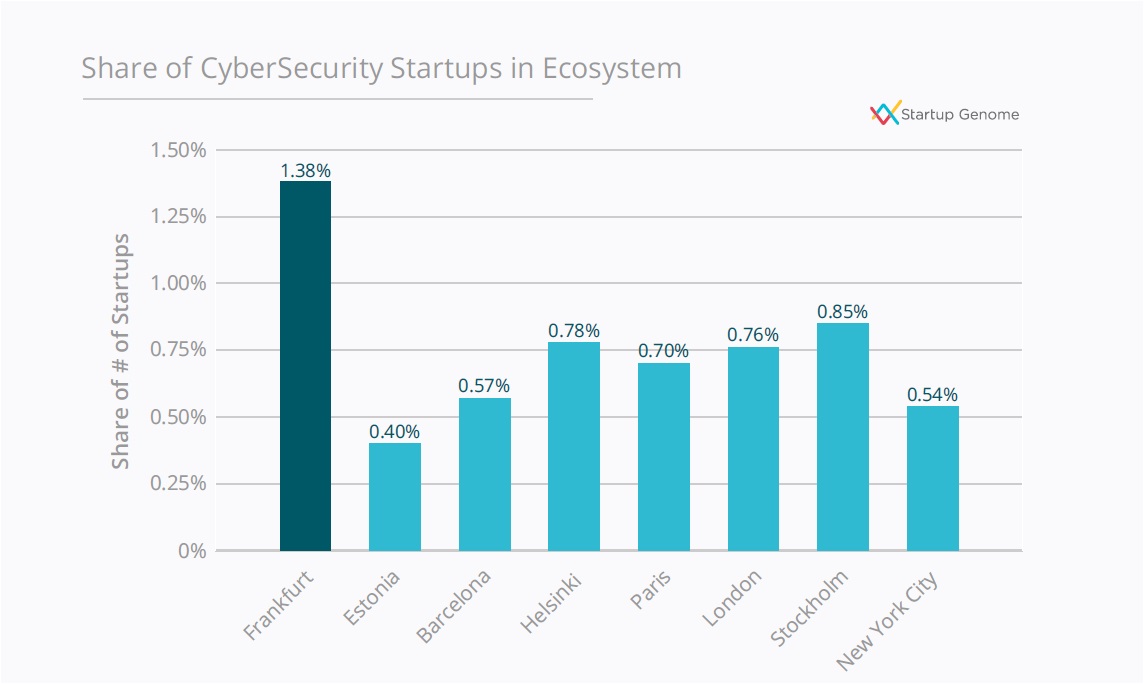
One area where Frankfurt is pacing ahead the peer ecosystems is with regards to the share of cybersecurity startups in the ecosystem. Approximately 1.38% of total tech startups in Frankfurt comprise of startups providing cybersecurity services.
Spotlight on Community Builders – Featuring Rhein-Main Startups’ Paul Herwarth von Bittenfeld and Pedro Ferreira
Spotlight on Community Builders – Featuring Rhein-Main Startups’ Paul Herwarth von Bittenfeld and Pedro Ferreira
While the name does not naturally find itself in the conversation when it comes to startup ecosystems, Frankfurt is progressivelly establishing itself as a up-and-coming global hotspot for aspiring founders and entrepreneurs, especially in the Fintech sector. Due to its large talent pool, its positioning as the financial center of continental Europe, its tight knit community and global connectedness, there are solid foundations on which to build, as was described in the latest Frankfurt Startup Ecosystem Report.
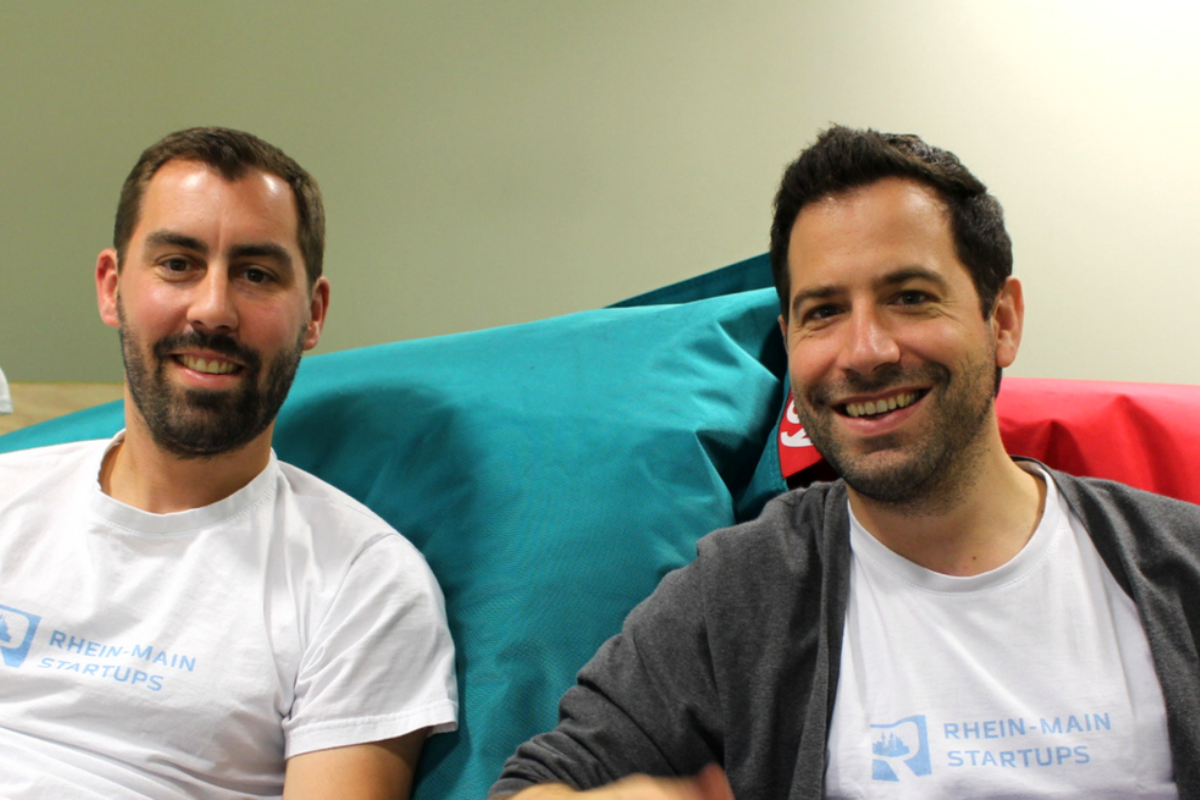
For our second interview with FFM community builders, we sat down with two well-known faces for local startups, Paul Herwarth von Bittenfeld and Pedro Ferreira from Rhein-Main Startups. Involved for years now in developing the local startup scene, they are, better than most, well equipped to tell us about the opportunity and challenges that can be found for startups in Frankfurt. Paul is the founder of Rhein-Main Startups and a partner at //SEIBERT/MEDIA in Wiesbaden, while Pedro is a long-time contributor, networker and event organizer extraordinaire, and now Managing Director at Start Zero.
We covered lots of ground and various interesting angles from the local ecosystem, we hope you enjoy the content! And thank you to Paul and Pedro for a great chat.
Got feedback? Comments? Suggestions? Let me know at paquin@techquartier.com
From corporate banker to head of a startup – An interview with Torsten Sonntag, CFO and COO at VERIMI
From corporate banker to head of a startup – An interview with Torsten Sonntag, CFO and COO at VERIMI
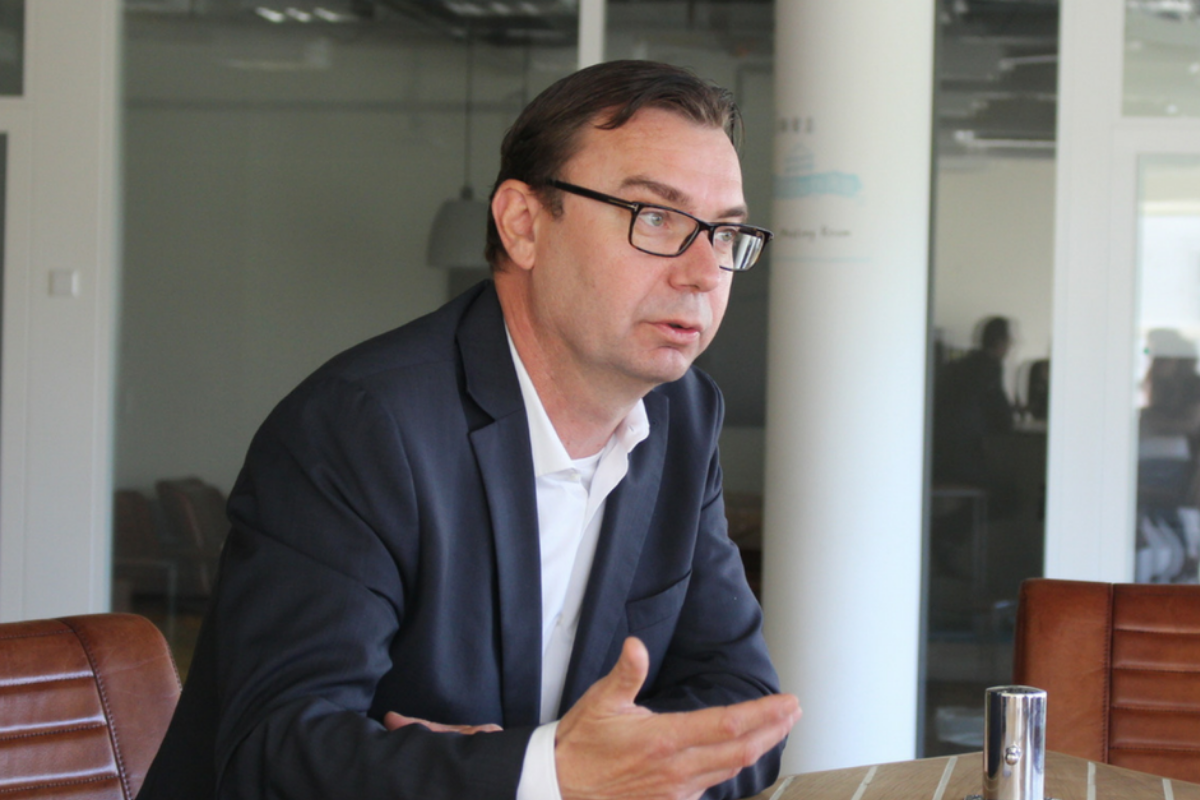
Torsten Sonntag was working for one of the biggest German banks for 26 years. Now, he manages VERIMI, the Frankfurt and Berlin-based user identity management platform. The startup is backed by 10 large European companies, namely Allianz, Daimler, Axel Springer, Deutsche Bank, Bundesdruckerei, Deutsche Telekom, Lufthansa, Giesecke + Devrient, CORE and Here Technologies.
After 11 months since it was founded, VERIMI rolled out its MVP (or Minimum Viable Product) on April 10th across Germany. I talked to Torsten Sonntag about VERIMI’s structure and decision-making, the positive and negative reactions after the launch, the company’s vision, its go-to market strategy as well as the sudden retreat of the CEO Donata Hopfen.
Understanding VERIMI
First off, I wanted to understand what VERIMI truly is. As I would not necessarily identify as a tech geek, I asked Torsten how he would explain VERIMI to someone like say, my grandmother. In a nutshell, VERIMI basically acts as your ID on the Internet; in the future, users will be able to store all different kinds of data safely in a verified state, which will allow them to open bank accounts, book flights, rent cars, get a mobile phone contract or shop clothes without having to enter their data on the different web services.
The aim of this initiative is to integrate the green VERIMI button on as many web services as possible. The respective web servers then connect with VERIMI and download the information the user is willing to transmit from the VERIMI platform. This will result in a higher convenience as the user no longer has to enter all the data again. One of the key advantages of VERIMI is that users retain full control over their own data.
However, VERIMI will not only provide identification services and data management, but also a payment service. Thus, I will be able to pay through VERIMI if I have deposited my bank data on the platform.
What is VERIMI able to offer now? What did you start with?
Right now, users can either enter their identity manually on VERIMI and be verified via a video identification process. Alternatively, a Deutsche Bank customer can transfer the already verified identity directly to VERIMI. In both cases, it is then possible to use the services of the first application partners: Deutsche Bank, Weltsparen, Compaio and Docyet with one click. Torsten understands this is still a rather small ecosystem, but he clarifies: ‘’Now that the MVP has been launched, we will gradually enlarge the ecosystem. We are working towards adding Allianz and Telekom. At the same time, we are in the process of fixing contracts with many companies outside the circle of partners, increasing the platform’s reach and relevance”.
So VERIMI is a platform created by some of the biggest companies in Europe – who came up with the original idea?
In the financial industry, identity management is a highly relevant topic. Thus, it is no surprise that in 2016 CORE and Torsten Sonntag’s former employer Deutsche Bank teamed up to initiate this project. As they soon realized that the topic is highly relevant in many industries it was easy to win the 10 current partners. “I think the accolade was when Bundesdruckerei joined the consortium because they believe that it is possible to digitise the ID card with VERIMI, which has not yet been achieved in Germany.”
Was there a concern to develop a product that would not be proprietary, in the sense that other organizations, even competing bank, would be able to offer the service to their customer base? In other words, is the incentive more financial than strategic?
Torsten agrees that this conflict would be quite presumable, but he believes that “by now, German companies have realized that each individual participant from any industry is too small to be able to compete globally, therefore the readiness to co-operate with national competition has become extremely high. So, the conflict to work with competitors exists, but one is prepared to accept it and to pull together in order not to fall behind the powerful global companies.”
What about the spirit among the 10 partners? Is there a majority stakeholder, and how do negotiations work internally?
When I heard about the various stakeholders I imagined the negotiations and decision making to be rather complicated. From Torsten, I learned that all stakeholders have equal rights. He agrees that sometimes the number of parties involved can create challenges, but “with a good governance process you get this handled very well” and the fast implementation of the project seems to prove his claim.
However, not everything has run smoothly until now. Shortly after the launch, VERIMI announced that CEO Donata Hopfen left. How are you dealing with this change of leadership and what were the reasons?
Apparently, a difference in vision about dealing with user data and distribution of decision making power among the three managing directors led to change in leadership.
Torsten does not see this change as a problem: “VERIMI has shown how quickly and situation-related we are able to react and find solutions quickly. With Jeaneatte Ratibor, we now have a colleague from Telekom in the management who has worked on the topic for over 12 months. We can thus move forward with high speed and without endangering our roadmap. Actually, it is a perfect solution. These things happen, and it is important to find a good solution that ensures high continuity.”
How was the feedback after the launch and what is your go-to-market strategy?
Every startup has to deal with critical voices. VERIMI apparently got a lot of positive feedback, especially for being able to launch after only 11 months. However, the main critical point was that one cannot really do a lot with it yet. Torsten agrees, but he says that this is part of the strategy and explains how:
VERIMI, like any other platform, has the classic chicken and egg problem. If there are no users on the platform, how is it interesting for web services (application partners), and vice versa? This is where the 10 partners come into play: on the one hand VERIMI tries to generate exponential user growth by activating the identity data of the partner’s existing customers and thereby become more attractive to other potential partners, thus growing rapidly and becoming more attractive for both users and web services.
However, providing a clear VERIMI USP is also a vital part of the strategy. ‘’We will be the first provider for verified identities in the digital environment in Germany. You can use your Google, Facebook or Amazon identity, but these are not verified identities and for certain use cases this will be needed in the future. For example, services in the financial industry, in the mobility sector, or for the entire e-government sector (which is currently under development). Thus, only through the service of VERIMI, it will be possible to use certain use cases in the future. That is our USP and that also sets us apart from competitors”.
Speaking of competitors, is there a race towards mainstream adoption between you and other initiatives like EUROPEAN NETID FOUNDATION (by Mediengruppe RTL Deutschland, ProSiebenSat.1 and United Internet)?
The market for ID management is slowly establishing and several initiatives have formed. VERIMI is the first to go live and is willing to co-operate but is also ready to compete: “We have a high willingness to find cooperative solutions even if we are not yet there. In the end, we believe that with VERIMI we will have a more comprehensive range of services at our disposal than other initiatives. We also believe that with the early go-live of the platform we have a certain lead in the market and are thus actually quite positively positioned in shaping it.”
How are you planning on expanding the business outside of Germany? Are the US and China also attractive for VERIMI?
“VERIMI has a clear strategic focus on Europe.” Torsten explains and emphasizes that even this task will be challenging enough, as a single go-to-market strategy for Europe won’t be possible; some countries have not really taken up this topic, while others already have similar initiatives. So, the strategies will range from simple implementation of VERIMI, co-operation with players that already exist and VERIMI franchise models. However, in order to pursue any of the strategies VERIMI strives to become an eIDAs certified trust service provider by the end of the year, which is the prerequisite for the service to be recognized in any other European country.
“Once we have gradually completed our European strategy then there is the possibility to think beyond the European borders but in the next step we think about Europe.”
Torsten is happy with the new challenge of working in a startup after 26 years of corporate life. Taking care of everything from scratch, from recruiting people to installing printers, are all hands-on topics, which he enjoys tackling with his new team. I wish Torsten and the whole VERIMI team all the best for their ambitious goal and I hope to shop my Christmas presents with one click on the green VERIMI button soon!

Interview with Mona Szyperski and Anna Domascan from Women TechMakers
Interview with Mona Szyperski and Anna Domascan from Women TechMakers
Diversity and gender representation in the field of tech is a hot topic, and it has been for some time. Headlines about tech being an all-white male club have been well documented over the years, the ratio of men against women still currently hovering around 80/20. With the ever-growing influence of tech in all aspect of our lives, and with the future of work being clearly geared towards digital skill sets, the issue is one that has important ramification. It is therefore important that access to the tech sector remain open and fair, that the the playing field be as levelled as possible and that opportunities be dependent on merit alone, not on gender.

Thankfully, a lot of initiatives are being put in place to give a voice to underrepresented groups in Frankfurt Rhein-Main region. Initiatives like Techettes Frankfurt, ‘’Women who Inspire Rhein-Main Startups’’, Code Door and Digital Media Women are great examples of grassroot, volunteer initiatives that are doing their share to close the gender gap through education and networking. Another such organization is Women Techmakers, an international network with a very involved local meetup in Frankfurt and with whom we had the opportunity to sit down with for a very stimulating chat.
We met with Mona Szyperski, Marketing Executive at technology consulting firm FDM Group, and Anna Domascan, Integration Engineer at Lucht Probst Associates GmbH, who are both involved as organizers and who generously accepted to present to us the work done since the launch in January 2017.
First off, first those who don’t know, could you briefly explain the role of Women Techmakers?
Mona: It started off in 2012 as an initiative from Google, the idea being that women not only at Google but in the field of tech in general could make use a dedicated network to share experiences, connect with one another, organize events and educate younger generations about all the opportunities of tech. Since the original events in North America, the network has grown internationally with chapters in pretty much every region of the world.

What is the extent of the network in Germany?
Anna : It started off with Hamburg, now Berlin has its own chapter, Munich as well. For Frankfurt, the chapter was started in January 2017 and we are now a team of 6 core organizers – with one man I might add! We are all volunteers, and our skill sets are quite complimentary. Some have technical backgrounds, others are project managers, scrum masters and innovators. We try to organize one to two events every quarter.
What is the membership like, and what’s a typical WTM event?
Mona : I would say 30% to 40% are regulars, but mostly every event there is a majority of new people, either invited by their friends or curious about topic-specific content we put together. We do a lot of pairing, training and workshops. Back in May we had a really cool event where we ran 4 different workshops simultaneously, on Programmatic advertising, CSS, D3.js and React/Javascript.
If we talk about the purpose behind your group. Why is there a need for an organization like Women Techmakers? Isn’t there already many other coding groups that women could simply join and get the same results and actually, increase female representation in these existing structures?
Mona : It’s sometimes harder for women to get into other groups, or at least to be more visible. And intimidating! We want to create a space where people can learn without complex, where there is a specific focus on welcoming and giving a voice to women.
Anna : That said, it’s not a female-only club. Men are most definitely accepted, and the last thing we want to do is actually create divisions. It would be great actually if Women Techmakers didn’t need to exist! But the lack of female role models is something real and that we feel we can address. Women groups are also typically very collaborative, supportive, and a great place to exchange ideas.
Why do you think the tech world is such a male-dominated sphere?
Mona : I think a lot of it is due to how we are as women. There is a certain tendency to stay back in public, to be cautious when it comes to take your place. If men are offered speaking engagement they are much more likely to jump at the chance, whereas women, even if they are very qualified, will sometimes pass up great opportunities because they feel they don’t have what it takes, or that they are not ready. All the more reason why providing them with a platform to build their confidence, giving a voice to successful women, enabling mentoring, is crucial.
Anna : From a personal standpoint, I have built a lot of confidence in my skills through Women Techmakers. By hosting events and talking in front of a small but very friendly crowd, writing articles about the events. A couple of years ago I joined the Web Monday team with roughly 70 people attending, currently our events have an audience of about 140, and it has been great for my self-confidence and gaining precious experience. That’s another takeaway that we see a lot : once women actually do take a step forward and accept to speak in public, they realize that they knew a lot more than they initially thought.
What can organizations do to help bridge the gender gap?
Anna : It needs to be a built-in feature that women will be part of the agenda. From the first planning meeting, organizations need to think about the need to include women. There are also a lot of organizations and women groups out there that can be asked for help, for example when there is a call for applicants or for speakers. Use them!
Mona : Yes exactly. In Frankfurt you have us, the Techettes, Fintech Ladies, or Digital Media Women. All have deep networks that can be leveraged. Just give us more than 4 weeks of heads-up; involve women already in the early planning stages! The idea here is not to create quotas; but we need to focus on diversity. Women want to be picked not because they are a woman, but because they are qualified. Still, there needs to at least be invitations to women experts, and since they might not be as numerous or visible, they need to be proactively seeked out.
I would also give the example of my own company, FDM, that is very involved in promoting inclusiveness. They have very much embraced my implication with Women Techmakers, it was actually quite an easy sell because of the strategic fit with the company.
Any final thoughts? What would you say women who want to get involved, or men wanting to help and make a difference?
Mona : I think women need to grow a thick skin – but that said, they still need to point out blatant sexist behaviors. Take your place, don’t be afraid to make yourself heard and take chances.
Anna : For men, I think they can definitely help by opening up their networks, by taking part in the dialogue, taking ownership of the issue and not painting our initiative as a ‘’feminist’’ group or something that divisive or negative. In the end, we all gain from being open minded and supportive, and to men I would say, you are welcome to join us a our nexts event!
CURRENTLY RECRUITING : We @WTM_Frankfurt are proudly announcing a joint scholarship program together with @Code_Door. Whoop whoop! >> APPLY NOW for the @udacity scholarship and start working on your nano degree. Drop us a line if this is something for you! #womenintech

Core Team of Women Techmakers Frankfurt:


AI series: Banking will transform. Will banks do too?
AI series: Banking will transform. Will banks do too?
Loathed and loved, artificial intelligence (AI) technologies are steadily making their way into more and more industries. According to a study conducted by Accenture for the Hessian Ministry of Finance, AI will increase German work productivity by 29 percent in 2035. The study predicts that the banking sector in particular could benefit from automation and AI, with an increase of gross value added of 4.3 percent.
But this could remain a mere projection, says Tarek Al-Wazir, the Hessian Minister of Finance. “AI will play an essential role in deciding the competitiveness of financial service providers. All their fields of activity, investment decisions, market instruments and portfolio management are affected by it and will be transformed.” Al-Wazir continues, “Without expertise in AI, banks could lose these fundamental areas of business to other players.”
The necessary changes are already underway. The rise and rapid growth of Fintechs in the Rhein-Main region demonstrates the potential in this field, particularly in Frankfurt where the stock exchange boasts 90% of German stock market turnover. The banking sector has been implementing AI largely through collaborations with start-ups such as these. Taking such steps is not only a necessity to stay in control of their business’ future, AI also offers multiple opportunities to transform and innovate individual organisations as well as the industry as a whole. Here are some examples of how:
Automatisation and streamlining
Chat bots and virtual consumer assistants are likely just the beginning. Banks and insurers are developing more and more ways to efficiently handle consumer inquiries which will lead to faster processing, for example, when handling standard insurance cases.
Innovation
AI offers a whole range of opportunities for new products and services that combine digital tools, big data handling and consumers’ needs for more flexibility and personalisation. One such example, is a digital life insurance that automatically adjusts to the relevant phase of life and individual circumstances, as well as variances in fees and services.
Growth
An obvious point. For banks these new possibilities offer a whole variety of new business opportunities. As such, banks will transform not only towards there customers but also towards their employees. And they already are. Those working in the banking sector are more than prepared for the use of AI within their organization: more than 70 percent say they are expecting more and more AI technologies in their work environment within the coming years.
The study suggests that those who embrace these opportunities will be rewarded. Even with AI technology in its early stages, almost two-thirds of consumers today are prepared to grant greater access to their personal data in exchange for better and more personalised services. After years of cutting back on local branches and touch points, this may actually be the opportunity for financial industries to win back consumers.
This article is part of Techobservers’ AI series, kicking off with the launch of “Hessens Ambitionen für Künstliche Intelligenz”, a roadmap to fostering AI in the Rhein-Main region.